Why Buying an Unapproved Plot in Faisalabad Can Cost You Everything
If you have been plot-hunting in Faisalabad lately, you have probably noticed something: some housing schemes offer plots at prices that seem almost too good to be true. Cheaper rates, flexible instalments, aggressive sales calls. And often, that's exactly the problem — because a lot of these schemes are selling land they were never legally allowed to sell in the first place.
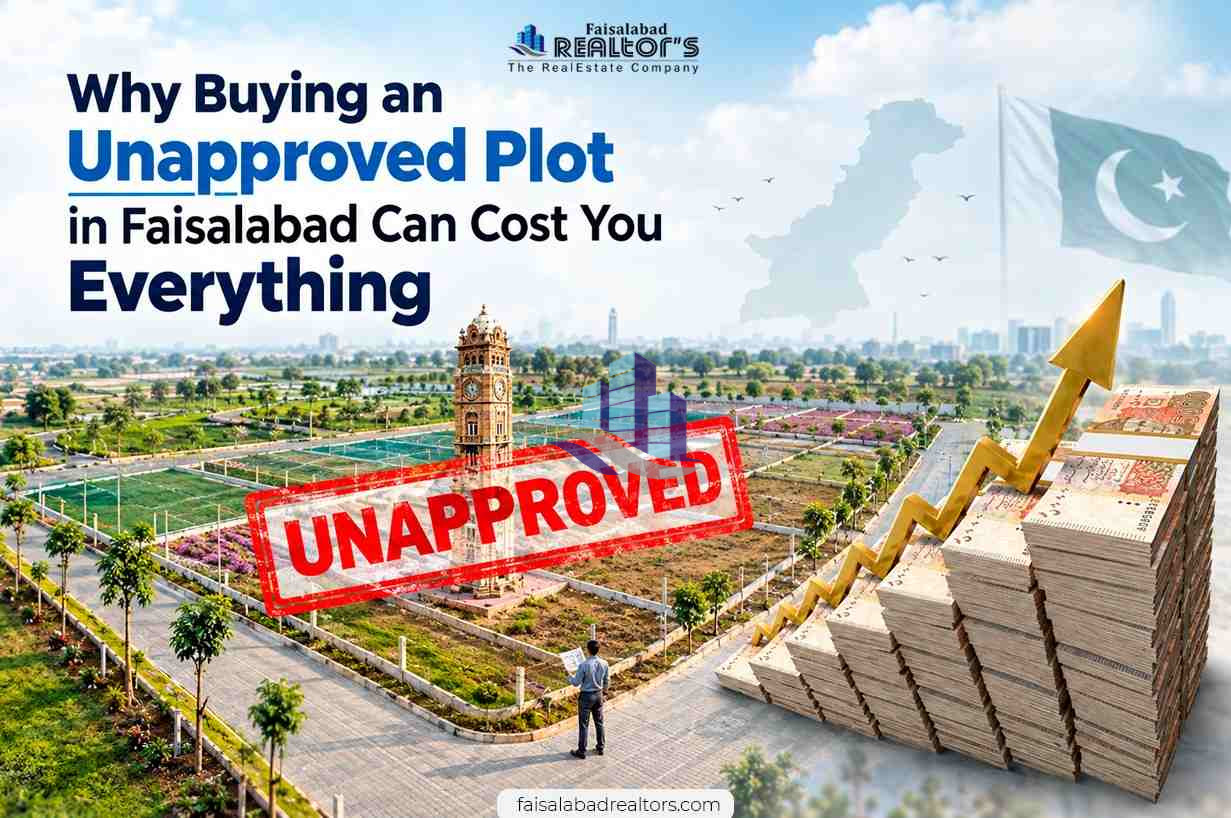
This isn't a rare or isolated issue in Faisalabad. It's something the Faisalabad Development Authority (FDA) deals with constantly, and the consequences for buyers can be serious.
What makes a scheme "unapproved" in the first place?
Under Pakistani law, specifically the Development of Citizens Act 1976 and the Local Government Ordinance 2001, any housing society in Faisalabad has to get FDA approval before it can legally start developing land or selling plots. That means getting a proper No Objection Certificate and having the layout plan officially sanctioned.
A lot of developers skip this. They buy agricultural or private land, carve it into plots, print brochures, open a sales office, and start collecting money — all before the FDA has signed off on any of it. Legally speaking, that land was never cleared to be sold as a housing scheme, no matter how official the paperwork looks or how many people have already "bought in."
This isn't hypothetical: the FDA acts on it regularly
Faisalabad has seen this play out again and again. The FDA has sealed illegal housing schemes on Sargodha Road and demolished illegal structures built inside them, after finding the developers were selling plots without ever getting approval.
In one of the bigger operations, the FDA sealed and demolished nine illegal societies on Satiana Road in a single sweep, arresting people involved in selling the plots and handing them over to the police — with the authority expecting to recover around PKR 300 million in fines from the owners involved.
Another round of enforcement saw four illegally developed schemes sealed outright, with developers told to stop selling plots entirely until their approval status could be sorted out.
So this is an active, ongoing risk — not something that happened once years ago and got fixed.
What actually goes wrong for the buyer
The scary part isn't just that the scheme is illegal. It's what that means for whoever already paid for a plot in it.
If the FDA seals or demolishes the scheme, there's usually no clean way to get your money back. Developers behind these projects tend to vanish or claim they have nothing left once enforcement starts. And even before it gets to that point, you're dealing with land that has no real legal backing — allotment letters from an unapproved developer don't hold up the way a proper title does, so ownership disputes down the line are common.
Then there's the practical side. Unapproved schemes almost never have proper roads, sewerage, gas, or electricity infrastructure, because that kind of development only happens once a scheme is officially sanctioned and coordinated with utility providers. So even if nothing goes legally wrong, you might end up owning a plot in the middle of nowhere with no way to actually build and live on it.
And if you do manage to construct something, it can still get flagged for demolition whenever the FDA runs its next anti-encroachment drive — which, based on the pattern in Faisalabad, happens fairly often.
Banks won't finance property like this either, which makes it hard to sell later even if you want out. You end up stuck holding land that's difficult to build on, difficult to finance, and difficult to resell.
How to actually check before you buy
The good news is that verifying a scheme takes very little effort compared to the risk of skipping it.
The FDA maintains and regularly updates a list of approved housing schemes, and FDA officials have publicly said people can visit the office directly to confirm details like land ownership, layout approval, and the current status of a scheme. FDA Additional Director General Rizwan Nazir has specifically urged people to inquire before investing, precisely to avoid exactly this kind of loss.
Before you commit to anything, it's worth doing a few basic things: check the FDA's approved list yourself rather than trusting what a sales agent tells you, ask for the actual NOC and layout approval documents, and pull the land record (Fard) and mutation history to confirm the title is clean. If a deal is priced noticeably below the market rate, that's usually a signal to slow down and check more carefully, not move faster.
Working with a real estate agency that actually verifies approval status — instead of just relaying the developer's claims — makes this whole process a lot less risky.
Bottom line
Faisalabad still has plenty of solid, legitimate investment opportunities — plots in FDA-approved schemes with real infrastructure and clean titles. The issue was never the city or the market. It's skipping the ten minutes of verification that separates a safe purchase from a plot that might get sealed next year. Before you pay anything, confirm the scheme's status with the FDA. It's a small step that can save you from years of legal trouble.
If you're interested in any property sale or purchase, do contact us . We provide the best real estate services in Faisalabad.
Contact us for:
House for sale
House for rent
Room for Rent
Flat for Rent
Ideal Farm House
Commercial Avenues
Categories
Recent posts